
Read time: 5 minutes
If you are trying to build extra income around a job, with too little time, a careful budget and a full life, this issue has one message for you: you are more normal than you think.
At the start of September I put a short tool on my website: ten questions about your time, your money and your skills, which points to one of four paths, four ways of building extra income around a job. E-commerce, digital products, freelance work, content. In its first week more than a hundred people went through it, and every figure below is a percentage of that group.
Start with this one. Nine in ten of them are doing this around a full-time job.
Pattern one: almost nobody has "enough" time
Three in four said they can protect fewer than ten focused hours a week. The most common answer was five to ten hours. One in four said fewer than five. Only one in twelve said more than fifteen.
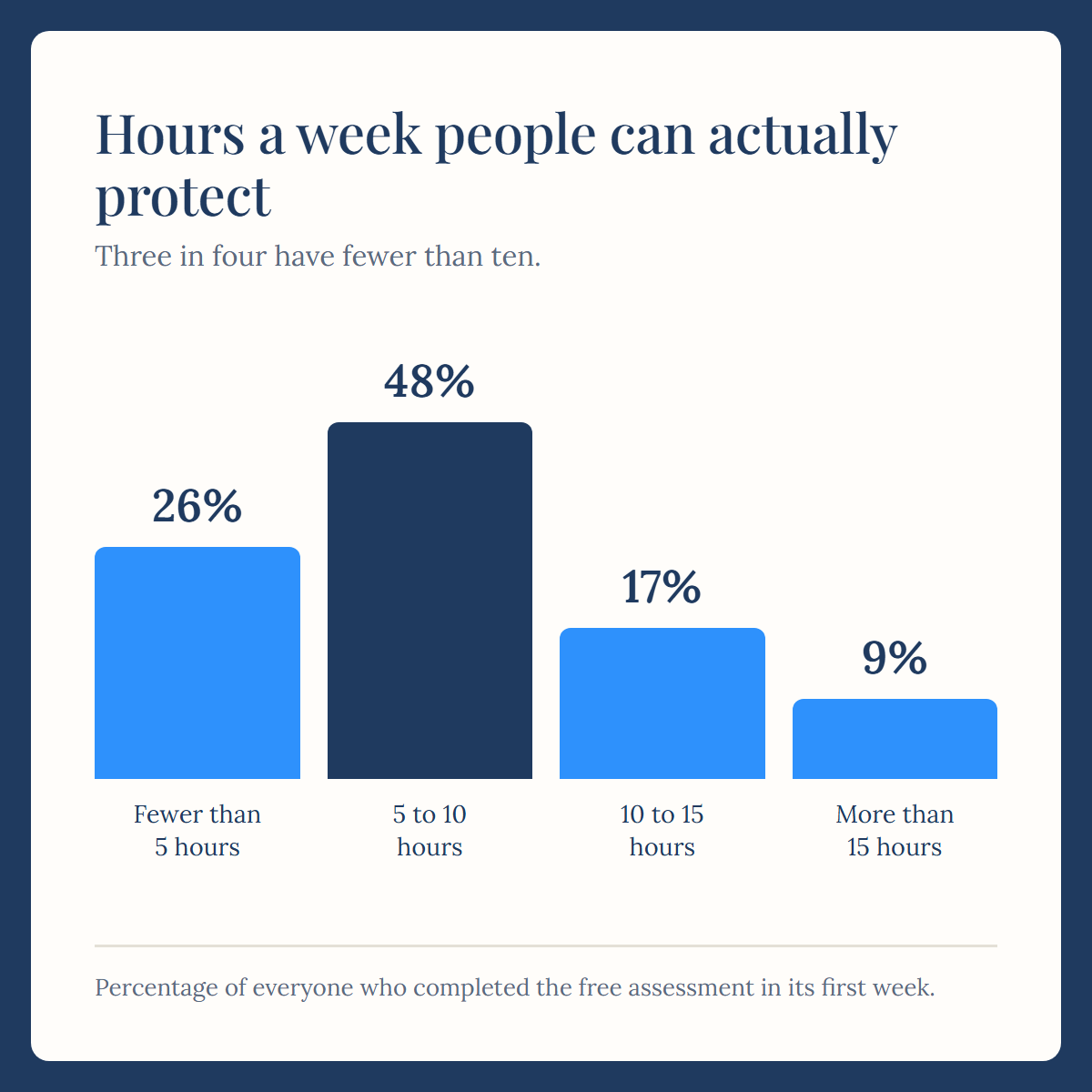
Here is why that matters. If that is you, you are not behind. You are normal. The plans that fail are the ones written for a person with endless evenings. The plans that work are small: a few booked hours, one task per day, one finished thing per week. Five booked hours that happen beat fifteen imagined ones. Building slowly is not the backup plan. For most of us, it is the only honest plan.
This matches my own start exactly. When I began in August 2024, I was working full time with a young family. My building time was evenings after the house went quiet, and a Sunday morning. Nobody gave me more hours. I built with the ones I had.
Pattern two: the money worry is smaller than people think
Asked what they could put in over the next ninety days without it hurting, nearly six in ten said under £1,000. The most common answer was £100 to £1,000. Only one in eight had £5,000 or more.
And here is the useful truth: two of the four paths, freelance and digital products, need almost no money at all. Content needs even less. Only e-commerce asks for real starting capital, and even there, a small first order is the smart way in.
If a lack of money has been your reason to wait, the honest answer is that a path exists for your budget today. The barrier is choosing, not spending.
One more honest note on money: the biggest cost in the first months is rarely cash. It is attention. Protect your few hours more carefully than your budget, because lost money returns and lost weeks do not.
Pattern three: more than half do not yet know what they would sell
This was the answer I did not expect. Asked which statement was most true of them, the most common choice, by a wide margin, was "honestly, I am still working that out". More than half of everyone who answered.
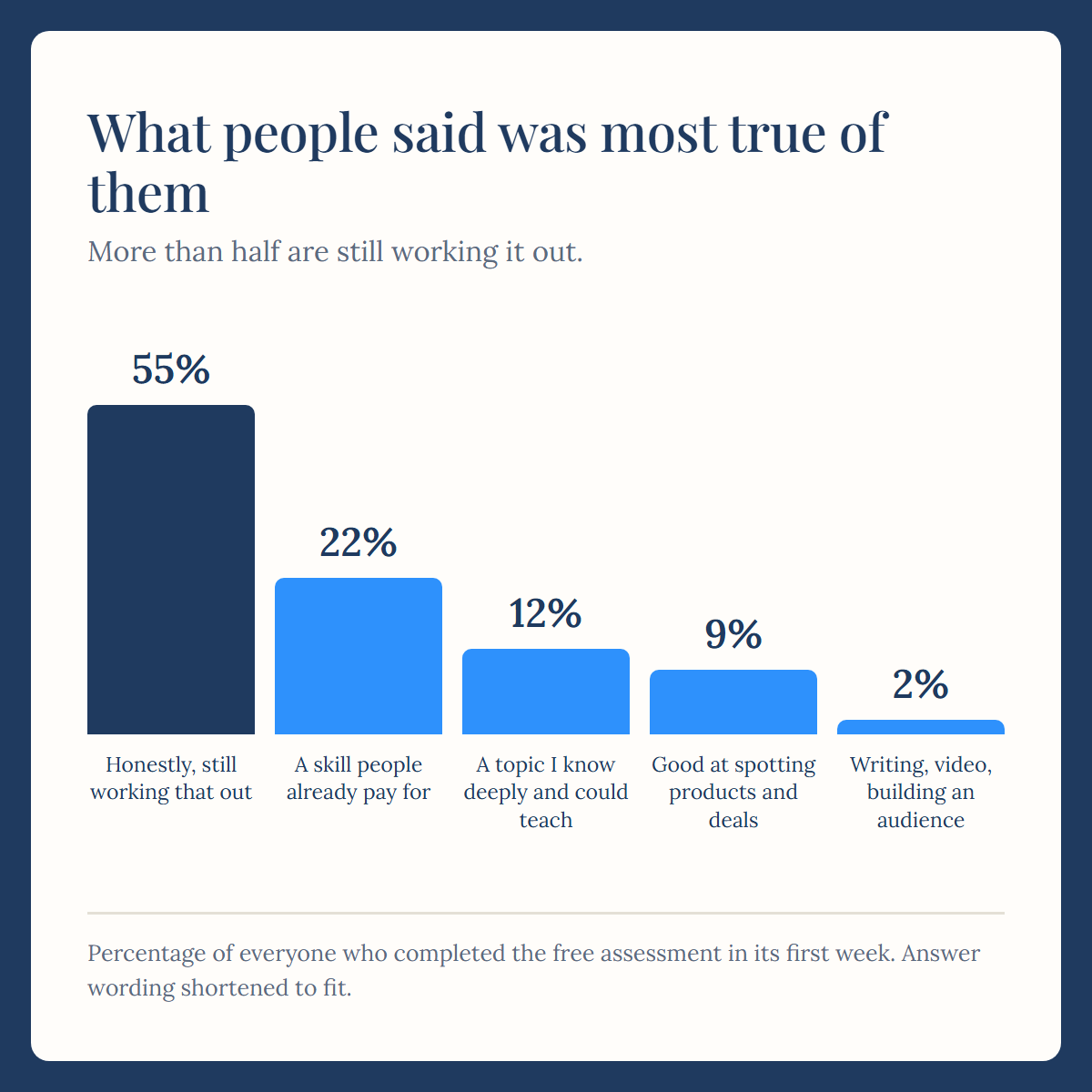
If that is you, read this slowly. You are in the majority, not behind everyone else. Most people arrive with no skill they feel sure of and no idea they believe in. The ones who get somewhere are not the ones who arrived with an answer. They are the ones who picked a direction anyway and let the work teach them the rest.
Pattern four: almost nobody is in a hurry
Half said six to twelve months is fine before the first money arrives. Only one in seven needed it within thirty days. And two in three described their appetite for risk as medium: test small, scale what works.
That is a lot of sensible people. It is also, almost word for word, the method this newsletter has been arguing for since June, arrived at independently by strangers.
Why some paths come up more often than others
All four paths came up. I am not going to rank them, because a ranking is the wrong way to read this, and it would push you towards a path for the worst possible reason: that other people got it.
It is worth understanding the shape, though. Look back at the answers above. This is a group that is employed, that can spend very little, that would rather build something once than trade hours forever, and that would mostly rather not be in front of a camera. Half are happy waiting six to twelve months. Put answers like those in front of anyone sensible who has run a business and ask which paths fit. You will get much the same answer: the ones that need no money up front, and that pay off a skill or a subject someone already knows. Not because they are better. Because they fit that description.
Change the answers and the path changes with them. Stock money and an eye for products points to e-commerce. A skill clients already pay for, and no objection to calls and invoices, points to freelance work. Someone who genuinely wants to be visible gets content. Each of those came up too, for the people they fit.
That is the entire reason the Parallel Income OS exists. It answers from your situation, not from whatever is loudest this month. The most popular path on the internet is simply the one with the best videos behind it. The right path for you is the one that matches the hours, the money and the skills you actually have.
Your homework
Compare yourself to the patterns above. Write down your real weekly hours and your real starting budget, and check your current plan against them. If the plan needs more than you have, the plan is wrong, not you. Shrink it until it fits, then do one thing a person with your real hours could finish this week: one supplier email, one page read, one profile made. Small fits your life. Small gets finished.
Coming next Monday
A personal one. What my own first month of building actually looked like, back at the kitchen table in August 2024. It was nothing like social media suggests.
See you then.
Izhar