

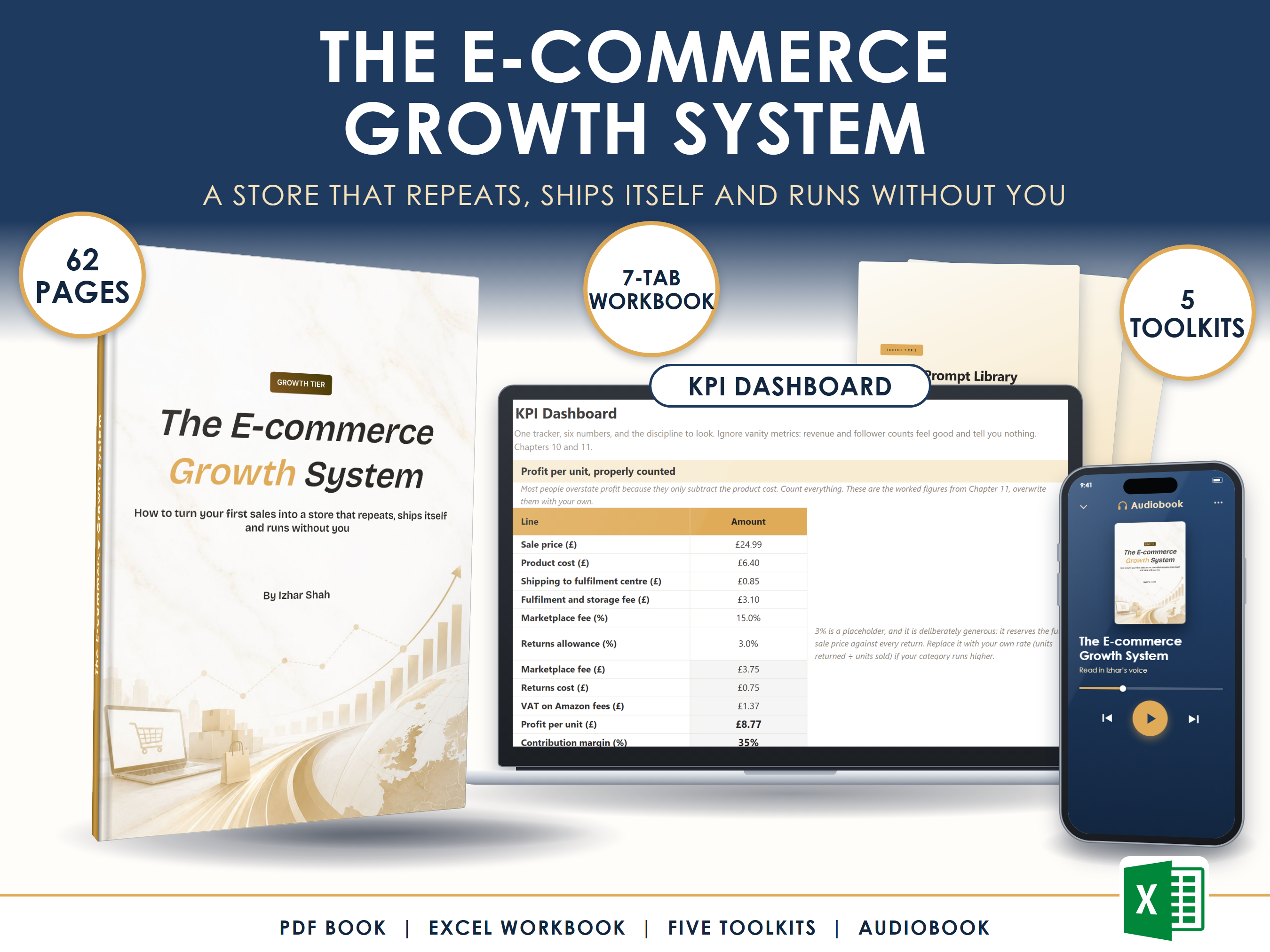
What you get
Four pieces, one system for turning a product that sells into a store that runs
The book is the thinking, the planner and the toolkits are the doing. Read a section, open the tab or toolkit it names, and fill in your own numbers as you go.
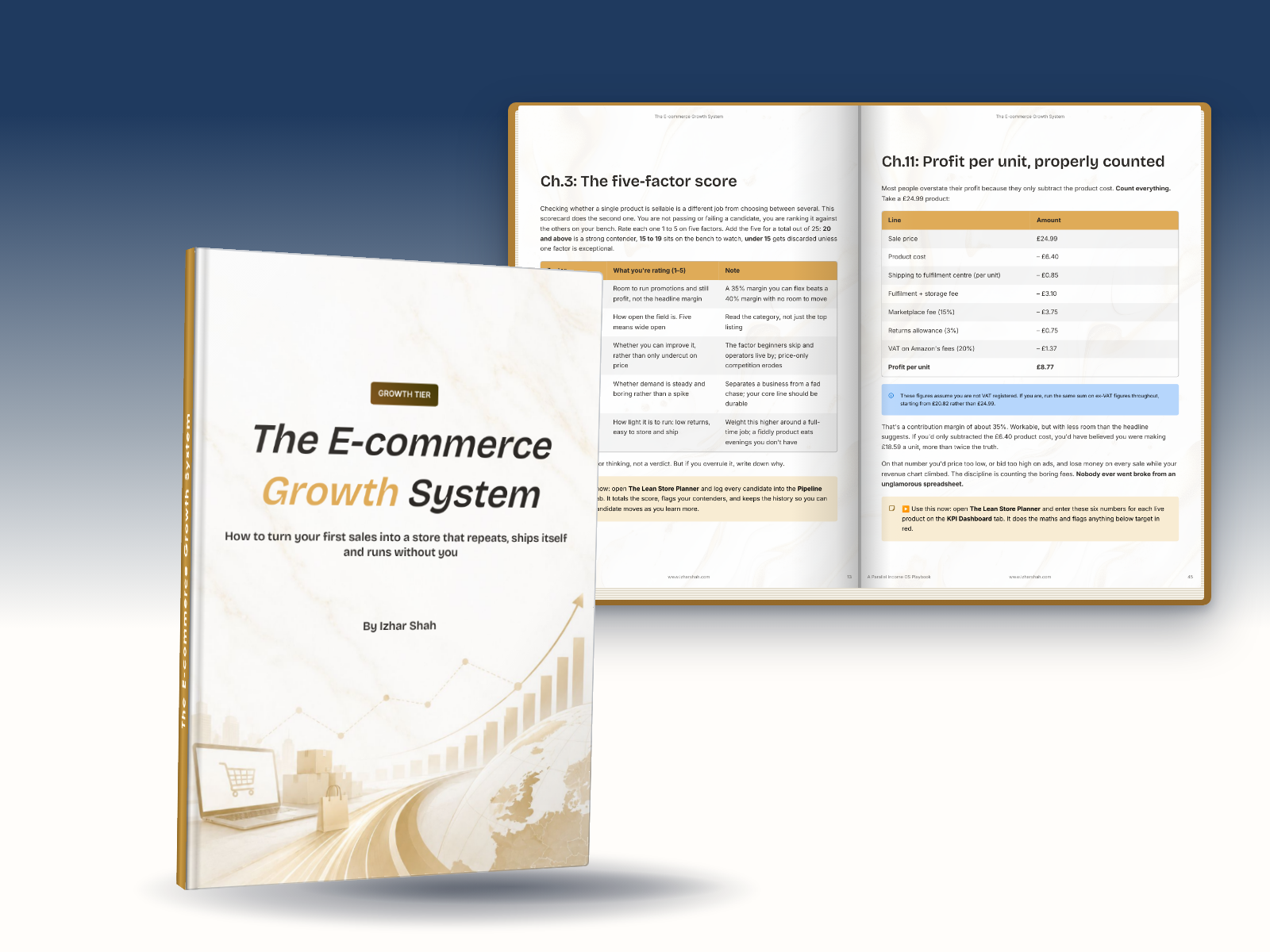
The book
The e-commerce growth system
62 pages: five systems across twelve chapters, in six parts, then the repeatable launch playbook, your first 30 days, the new terms and the FAQ. Worked examples and tables throughout, with a Use this now line that sends you to the planner or a toolkit.
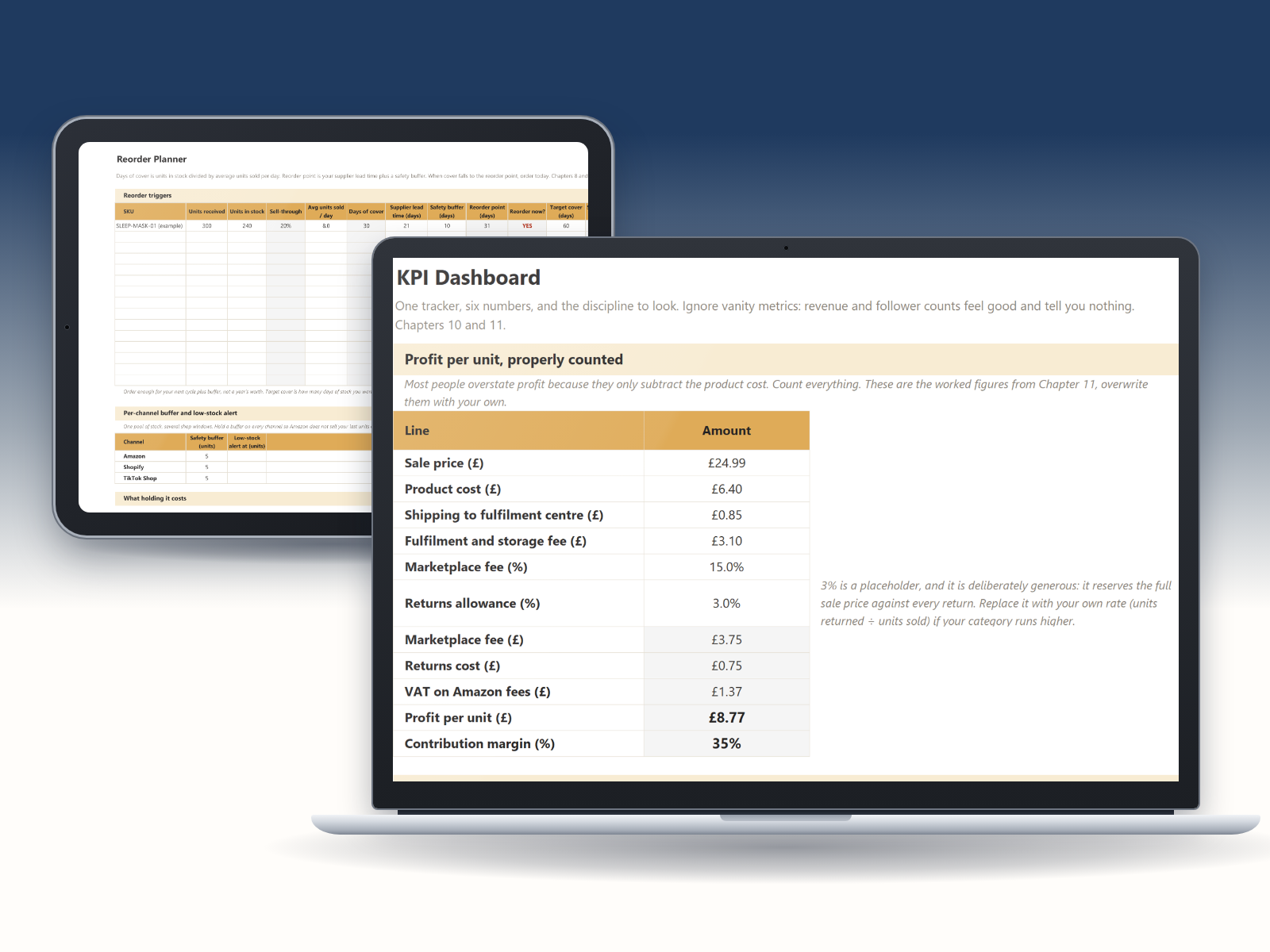
The workbook
The Lean Store Planner
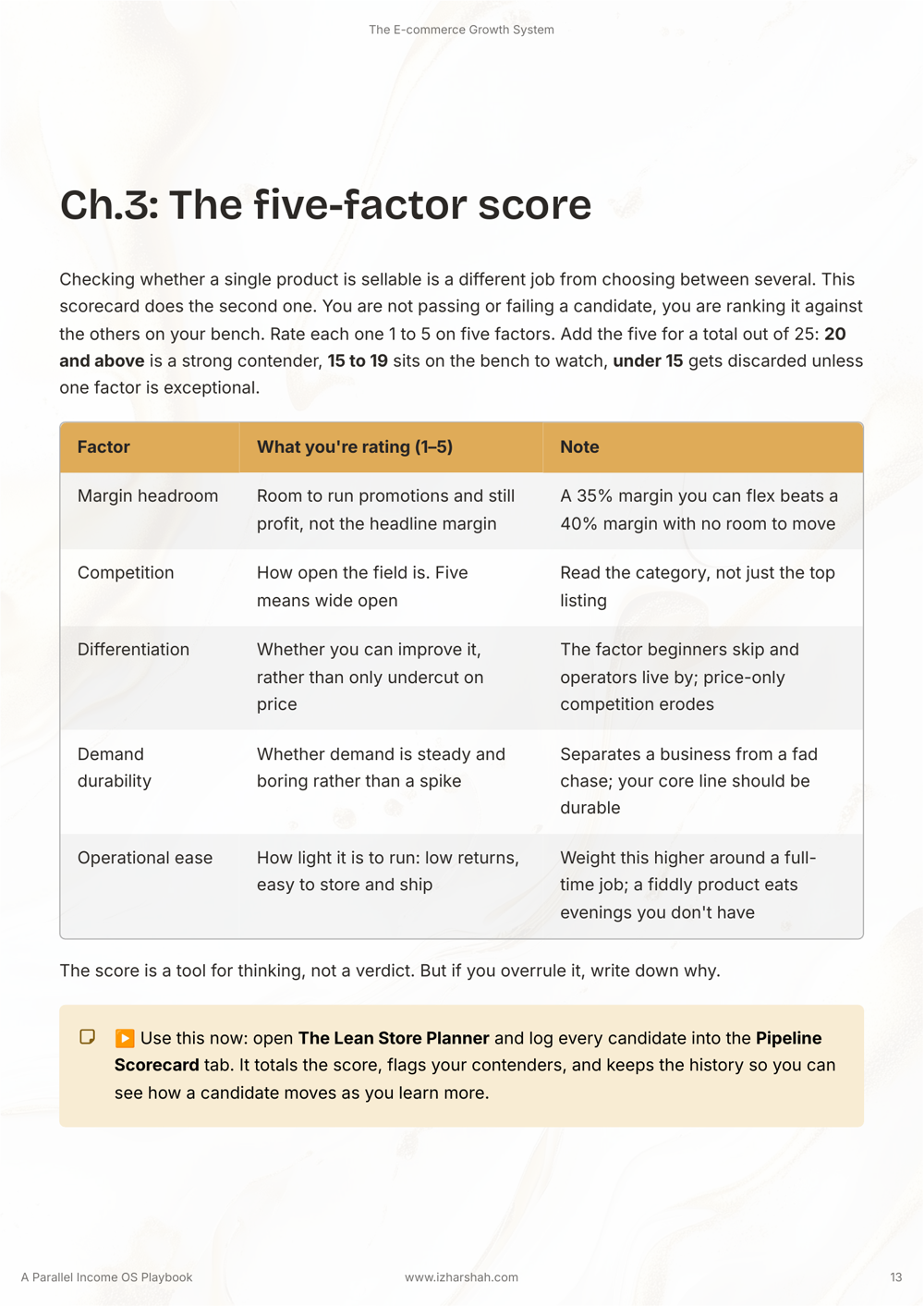
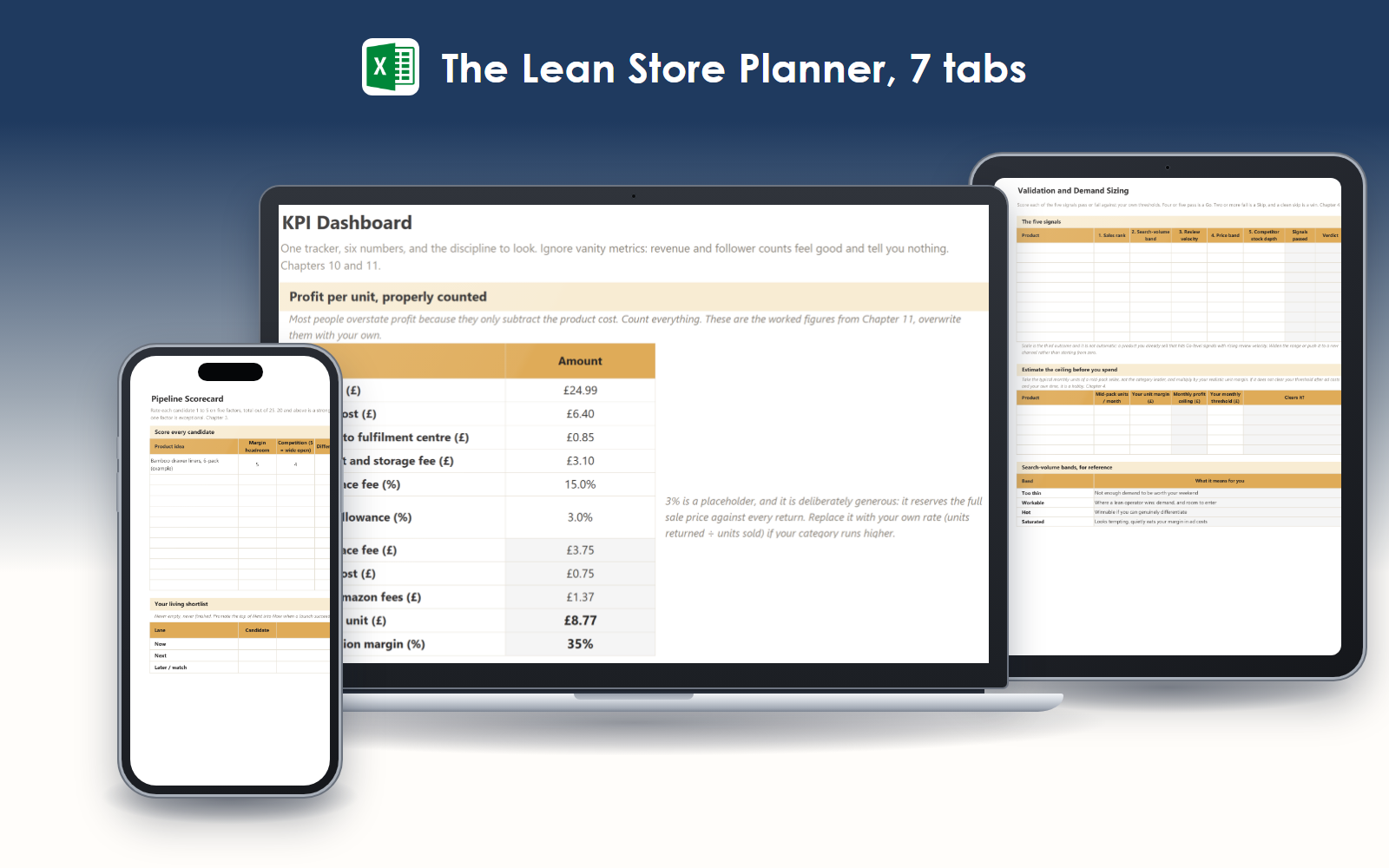
Seven tabs in one Excel workbook: your baseline, the pipeline scorecard, validation, brand positioning, the content calendar, the KPI dashboard and the reorder planner. The book's worked examples are already in place, so you can see each tab work before you type your own.
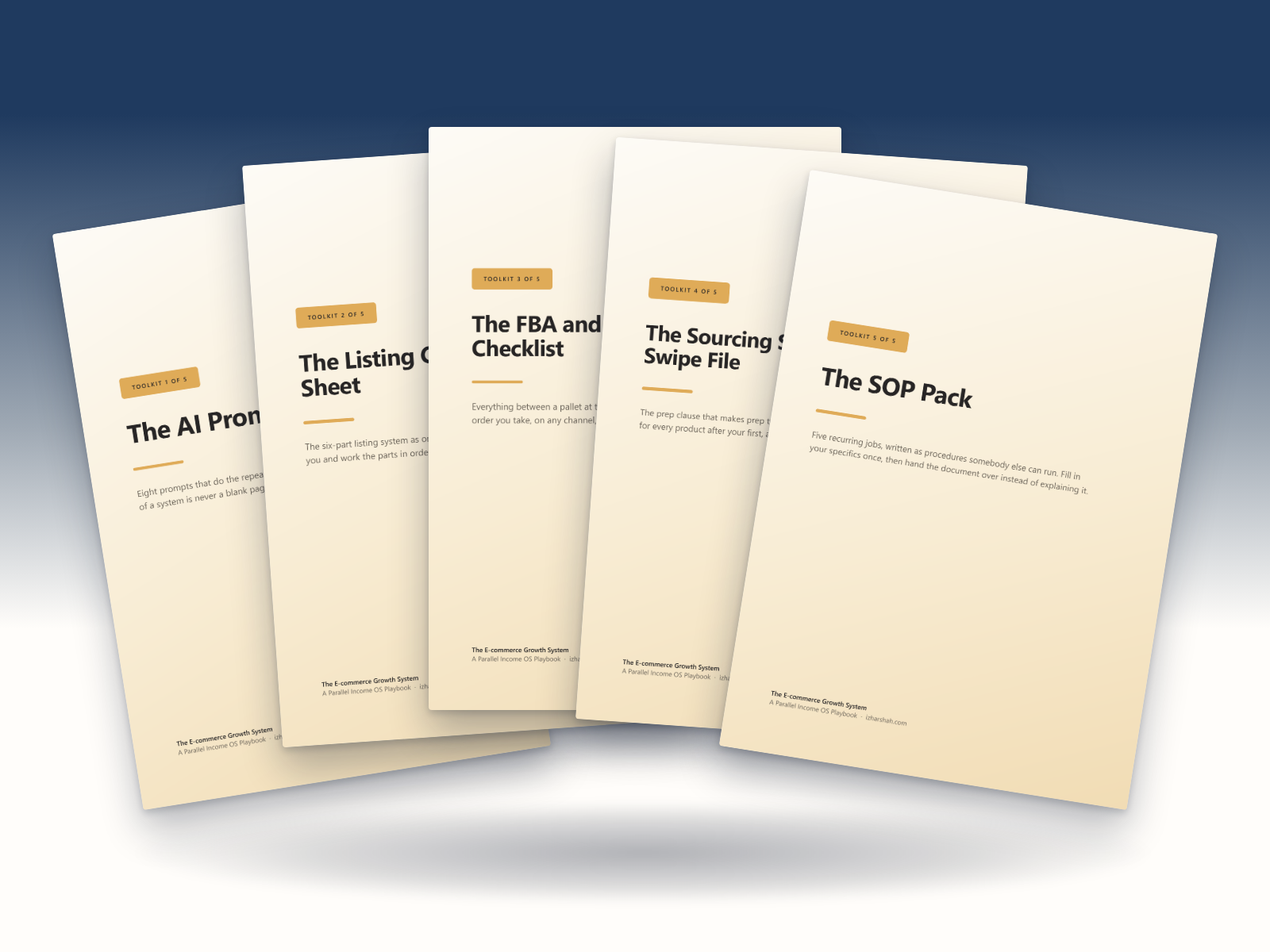
The toolkits
Five toolkits, one per system
Eight AI prompts for the repeatable writing, the listing system as a printable checklist, the FBA and MCF setup checklist, the supplier prep clause and messages, and five procedures written so somebody else can run them.
Included
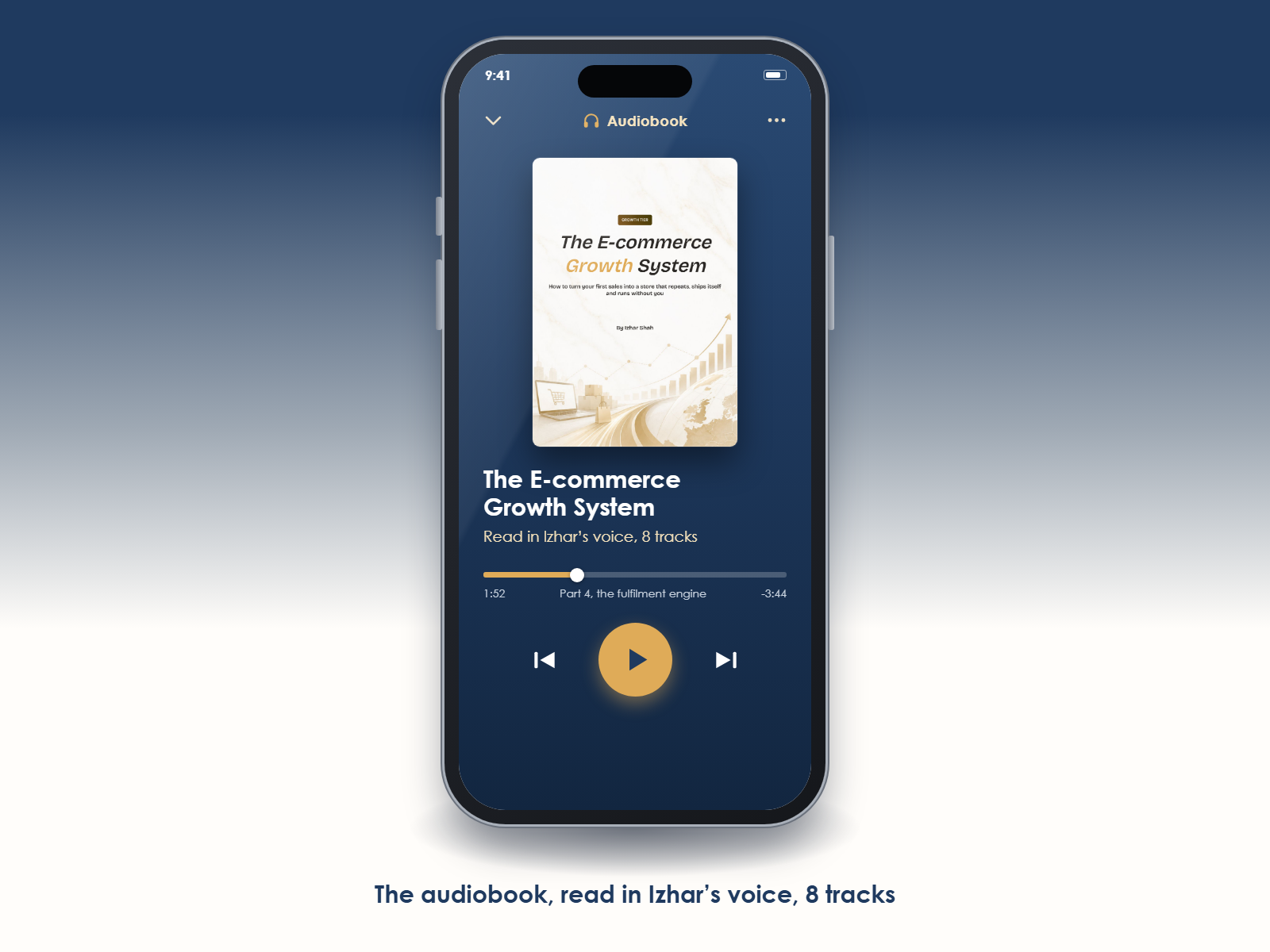
The audiobook, in Izhar's voice
Eight tracks that follow the book in order, about 42 minutes, for the commute or the walk. Tables are not read aloud; each track names the file and tab they live in. Read in Izhar's voice through a professional voice model trained on his own recordings.
How it works
How to grow an e-commerce business in five systems, around a job
A first sale is an event. A business is a system. The book takes your store apart into five working parts and builds them in the order the work happens.
- Product. A pipeline, not a lucky strike. Capture candidates as you go, score them out of 25 once a month, and size demand with five signals before you spend.
- Brand and store. Differentiation lifted from three-star reviews, a plan for the second purchase, and a listing system you reuse: a title formula, nine image slots, five bullets, one test at a time.
- Fulfilment. Amazon FBA holds the stock and Multi-Channel Fulfilment ships your Shopify and TikTok Shop orders from the same pool, with buffers that stop overselling.
- Traffic. A week of short videos batched in one session, six reusable hook shapes, and an email list with three automated flows.
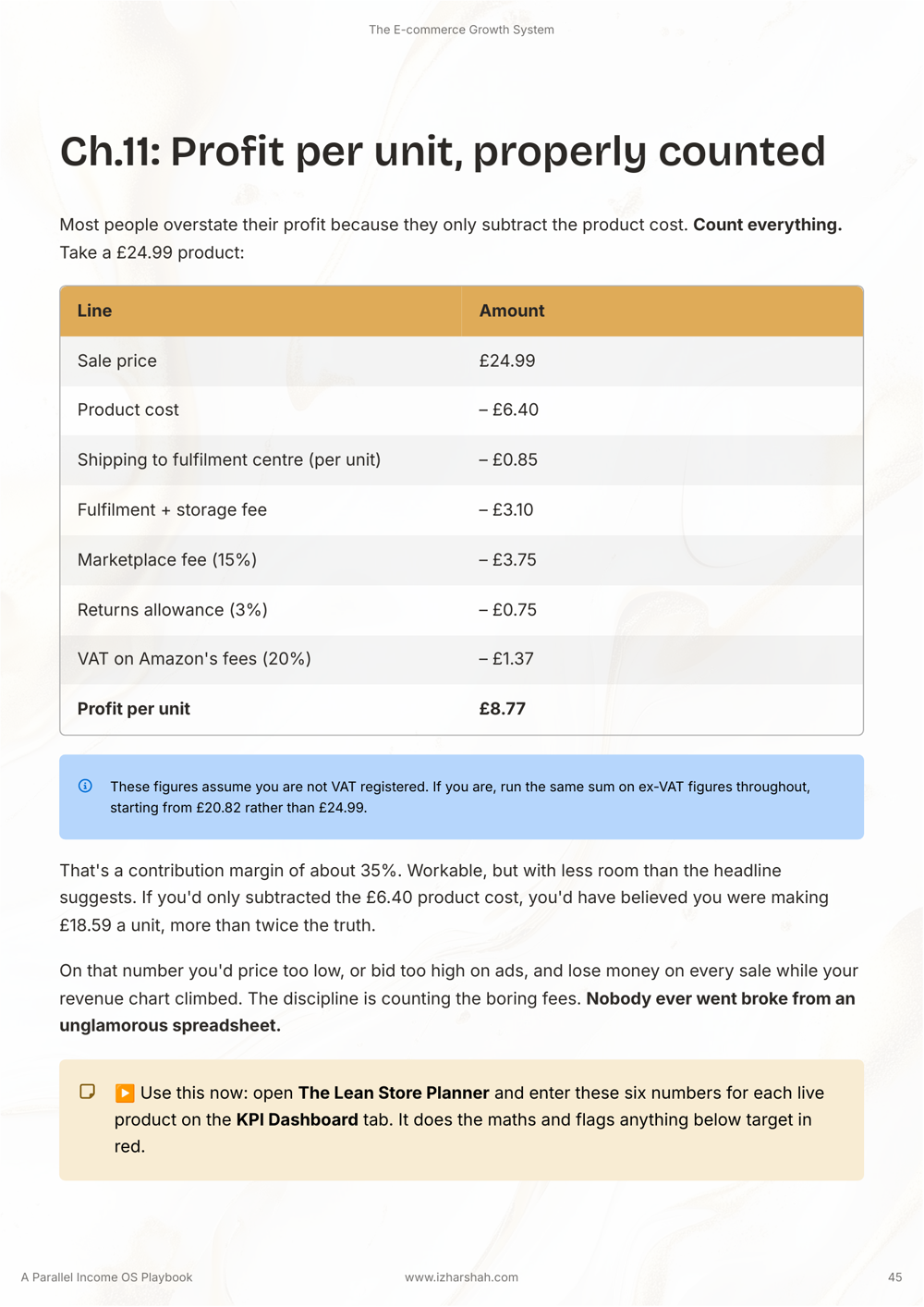
- Numbers and automation. Six numbers, profit per unit with every fee counted, reorder points, a cash buffer and a ten-minute weekly review. Then systemise, automate and delegate, in that order.
- Then run it again. The repeatable launch playbook puts the five systems back together as one sequence for product two, product three and every product after.
Inside the growth system
Worked examples, fixed formulas, and the tab to open next
Inside the workbook
Type your numbers. Read your answer.
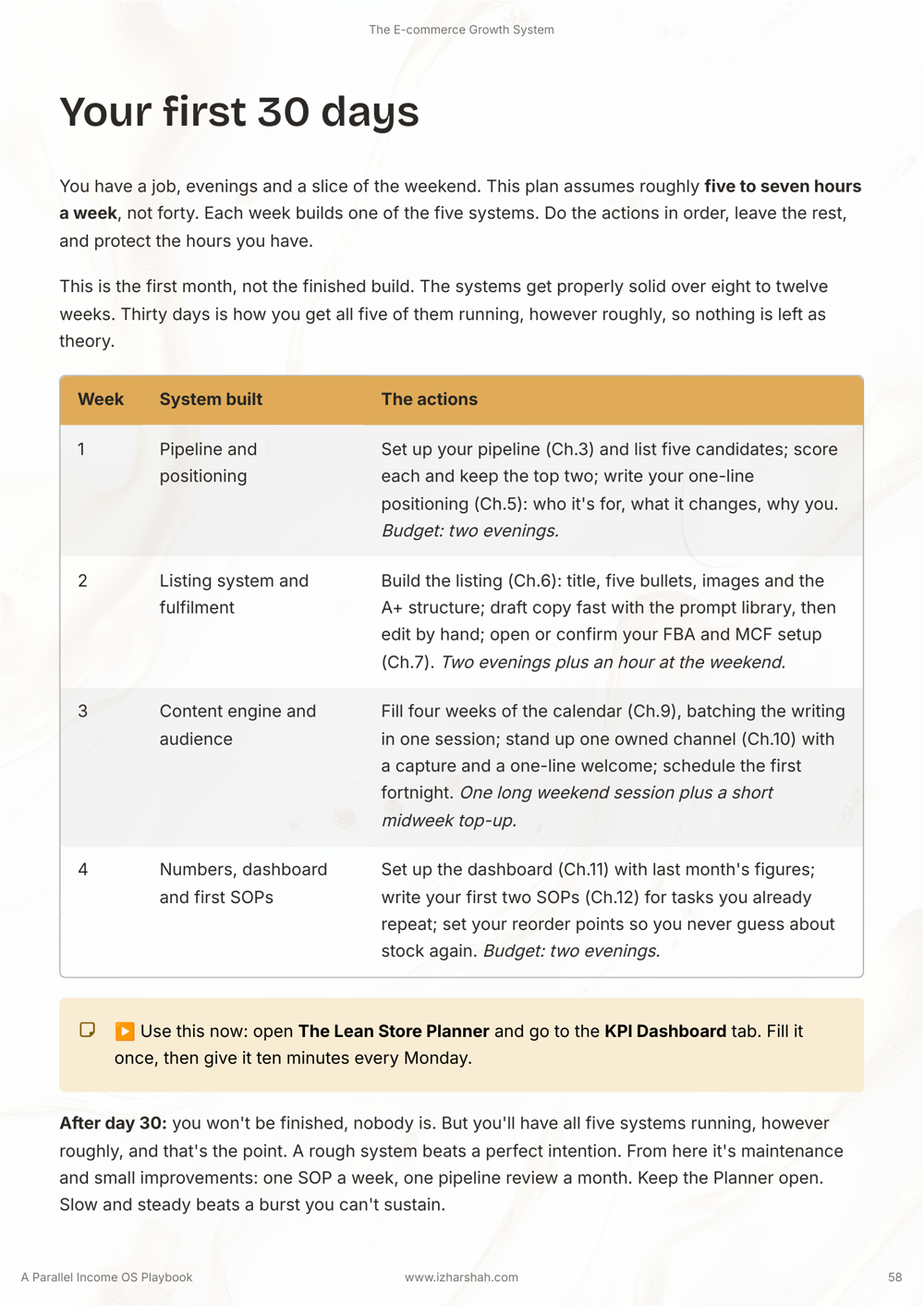
The KPI Dashboard counts profit per unit with every fee on its own line and puts a status beside each of the six numbers. The Reorder Planner turns your lead time, safety buffer and supplier minimum into days of cover, a reorder point and an order quantity, then compares what holding the stock costs.
One Excel file. Every framework, scorecard and checklist in the book has a home in it.
Inside the toolkits
Pull each one off the shelf when its chapter calls for it
- The AI Prompt Library. Eight prompts that do the repeatable writing, from adjacent products and review mining to bullets and hooks.
- The Listing Conversion Cheat Sheet. The six-part listing system as one printable checklist.
- The FBA and MCF Setup Checklist. Everything between a pallet at the factory and Amazon shipping every order, on any channel, from one pool of stock.
- The Sourcing SOP and Supplier Swipe File. The prep clause that makes prep the factory's job, and the messages that go with it.
- The SOP Pack. Five recurring jobs written as procedures somebody else can run.
The book, The Lean Store Planner and the five toolkits, with the audiobook included.
£149one paymentBuy now- Lifetime access
- Future updates included
- Secure checkout
Before you buy
Who it is for, and what it is not
It is for you if you are
- Selling already. A product live and real orders; the scorecards and the dashboard want your actual numbers.
- Working full time. Five to seven hours a week, one system at a time.
- Doing every task yourself. Systemise, automate, then delegate, in that order.
- Selling on more than one channel. One stock pool through FBA and MCF instead of split stock.
- Ready for product two. A pipeline and a launch loop you can repeat.
Worth knowing first
- It is not beginner material. First products and first supplier messages are not re-explained. Not selling yet? The E-commerce Launch Map comes first.
- It is not done for you. You build each system, with the planner and toolkits beside you.
- It is not a paid ads course. If you advertise, the dashboard tells you whether the spend buys profit.
- It is not a promise of income. Results depend on your work.
- It is not a quick fix. The systems get properly solid over eight to twelve weeks.
Who is behind it

Izhar Shah
An e-commerce brand of his own: built alongside his job at Jaguar Land Rover, left in August 2025 once it covered his number, past £500,000 in sales in its first twelve months. He teaches the system, not the leap.
Before the brand: three years in manufacturing, university lecturing, a PhD in Engineering, research at Imperial College London, and a specialist role at Jaguar Land Rover.
- March 2025the brand launched while he was still employed
- August 2025he left on a number set a year earlier
- Twelve monthspast £500,000 in sales from launch
Questions
The ones everyone asks
Do I need the Launch Map first?
No. The Growth System stands on its own. It assumes a product is live and some real orders have come in, however you got there. If you have not sold yet, The E-commerce Launch Map is the shorter road to a first order.
How is it different from the Launch Map?
The Launch Map gets a first product selling. The Growth System turns a product that sells into a store that runs: a pipeline for the next product, a listing system you reuse, FBA and MCF across channels, a content engine and an email list, and the numbers that tell you when to act. Nothing from the Launch Map is repeated.
How long does it take around a job?
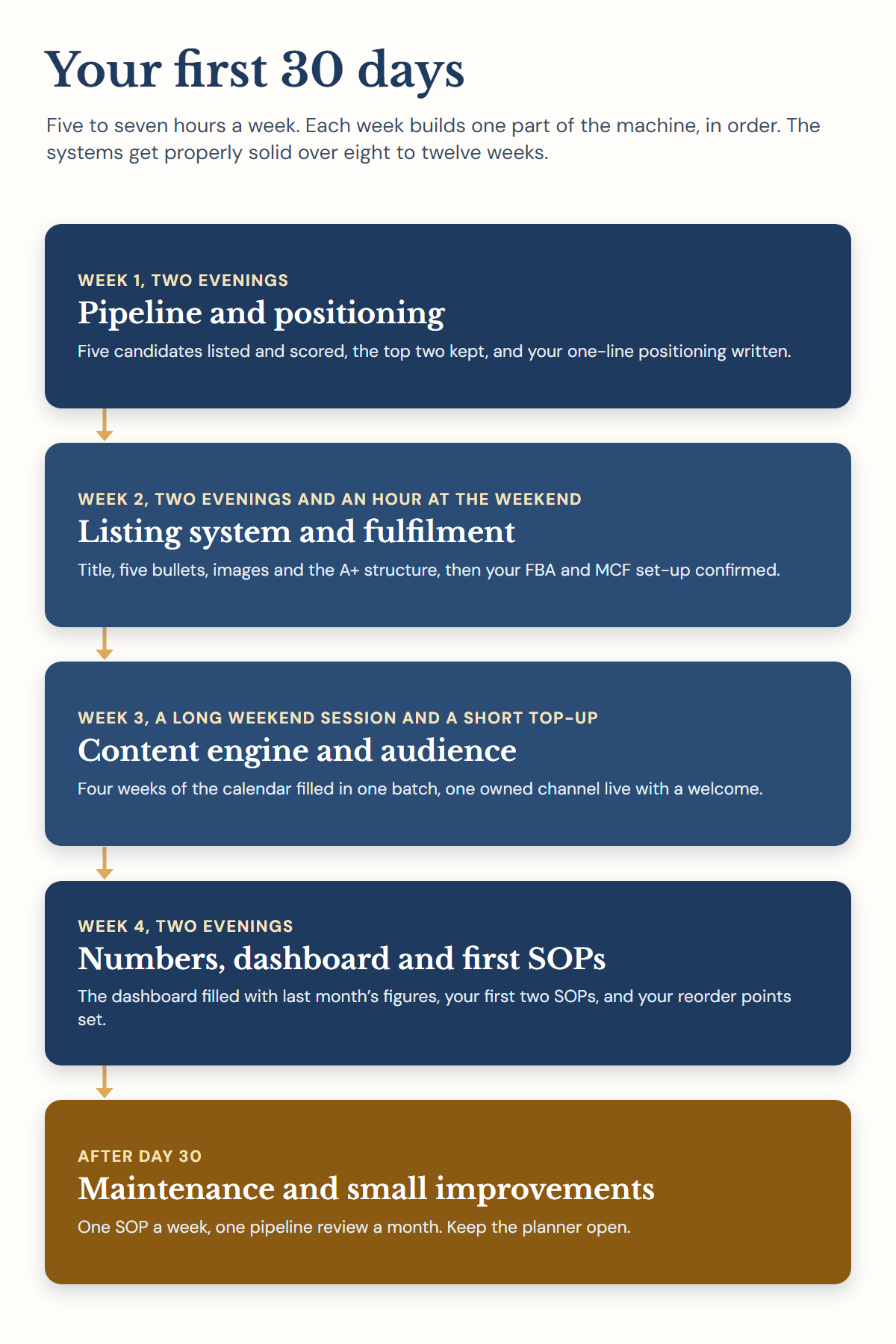
Plan for eight to twelve weeks of evenings and weekends. The first 30 days in the book get all five systems running, roughly, at five to seven hours a week: one system a week, with the time each week takes.
Do I have to sell on Amazon?
The fulfilment system is built on Amazon FBA and Multi-Channel Fulfilment: one pool of stock in Amazon's network, shipping your Amazon, Shopify and TikTok Shop orders. The book explains why it takes Amazon over a third-party warehouse, and when a warehouse earns its place. The product, brand, traffic and numbers systems work whichever channel you sell on.
I am not in the UK. Does it still work?
The method travels; the worked numbers are UK. The examples, the VAT notes and the Amazon fee figures are UK, and the planner is set up in pounds. Elsewhere, overwrite the fee cells with your own marketplace's figures and check your local tax rules.
Do I need a virtual assistant or a team?
No. Build every system yourself first, write the procedure as you go, then hand it over once it is boring and predictable. When you do hand work over, the book covers what to delegate first and the SOP Pack gives you the procedures.
Does it cover paid ads?
It covers whether ad spend is buying profit: CAC and ROAS sit on the dashboard beside profit per unit. It is not a campaign course. The traffic system is built on short videos and an email list you own.
What do I need to open the files?
A PDF reader for the book and the five toolkits, and Excel for The Lean Store Planner. The audiobook plays in your library, or in your own podcast app through a private feed.
Is the audiobook extra?
No. It comes with the Growth System: eight tracks that follow the book in order, about 42 minutes, in your library as its own item on the day you buy.
Is the audiobook the author's real voice?
It is Izhar's voice, read through a professional voice model trained on his own recordings.
Is this a subscription?
No, and it never becomes one. One payment covers lifetime access, and every future update to the files is included.
How do I get the files, and how do I ask a question?
Straight after checkout you are in your library: the book, The Lean Store Planner, the five toolkits and the audiobook. Nothing is posted. If a file will not open, reply to your receipt email and Izhar sorts it himself.
A store that runs without you is built one system at a time.
The book, The Lean Store Planner, the five toolkits and the audiobook. Start with the Start Here tab tonight.
£149one paymentBuy now- Lifetime access
- Future updates included
- Secure checkout
When the systems are working and the question becomes how far this goes, the next step is The E-commerce Scale Programme.